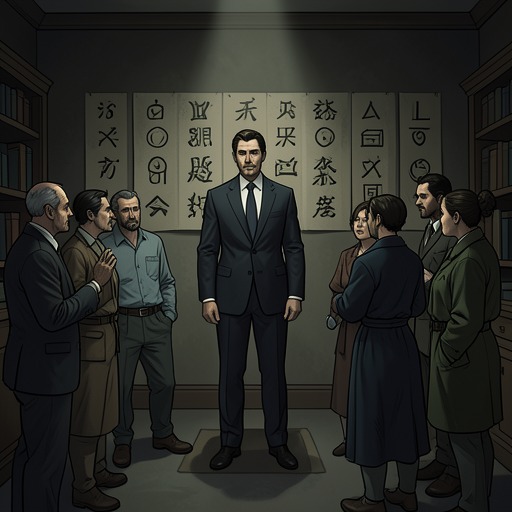
Universal Consciousness
The Lost SymbolUniversal Consciousness is the idea, as Katherine Solomon presents it, that minds are interconnected and that shared thought can have an exponentially greater effect than isolated thought. It is the central discovery she attributes to Noetic Science: not a merely spiritual metaphor, but a claim about the power of multiple minds acting together. The concept also gives Robert Langdon a way to connect collective consciousness with religious language and symbols encountered in the Capitol Rotunda.
Katherine Solomon’s Claim
Katherine explains that the influence of human thought grows exponentially with the number of people who share it. On her account, two minds working in unison do not simply double the effect of one mind; their combined influence becomes many times greater. She identifies prayer groups, healing circles, singing together, and mass worship as familiar forms of this collective force, and says that harnessing it could transform the world.
Katherine insists that Universal Consciousness belongs to scientific inquiry rather than to an ethereal New Age belief. She describes it as Noetic Science’s underlying discovery and says the phenomenon is already perceptible in the present. Her account treats shared consciousness as both a subject of research and a possibility with practical, far-reaching consequences; the passage presents this as her scientific conclusion, rather than independently demonstrating the claim.
Collective Thought in a Connected World
To show how the idea might operate in contemporary life, Katherine points to technology that links people in ways earlier generations could not have imagined. Twitter, Google, and Wikipedia, she argues, form a web of interconnected minds. The examples extend her account beyond traditional religious or communal practices: collective thought may also take shape through networks that let many people share, build, and circulate ideas.
Katherine forecasts that publication of her research will itself demonstrate the process. She expects people on Twitter to spread their interest in Noetic Science, causing attention to the subject to grow exponentially. The prediction makes communication both an illustration of her theory and a prospective means by which the theory might gain believers. Earlier in the conversation, the contrast between people who create and people who tear down leads to the prospect that a critical mass of believers can alter perception and bring a new reality into view.
Religious and Intellectual Connections
As Langdon lies beside Katherine on the catwalk beneath The Apotheosis of Washington, her explanation brings him back to ideas he associates with Plato’s account of the mind of the world and Jung’s collective unconscious. He thinks of these different traditions as pointing toward a shared possibility: that mind may be understood collectively rather than only as an individual possession. The scene does not equate the traditions in detail, but places them in conversation through Langdon’s reflections.
Langdon then connects the concept to Elohim, the Hebrew word for God in the Old Testament. He has wondered why the biblical word is plural; Katherine responds that divine plurality can be understood through the plurality of human minds. In this reading, God is not presented simply as a solitary consciousness, but as an idea related to many minds joined together. The connection turns Universal Consciousness from an abstract scientific proposal into a possible interpretation of scripture.
The Capitol Rotunda and the Many Made One
The setting gives Langdon’s realization a visual counterpart. After Katherine encourages him to return to the open-minded wonder of looking at the stars, he notices that the figures in The Apotheosis of Washington form two concentric circles, a shape he recognizes as a circumpunct. As he looks up at the fresco, he recalls the Latin words E pluribus unum, meaning “Out of many, one.” The image and motto gather the conversation’s separate strands into a compact symbol: plurality can form a unity without beginning as a single mind.
The concept therefore links Katherine’s proposed science, Langdon’s religious association, and the Capitol’s symbolic imagery. Its implications in the scene remain prospective: Katherine believes that grasping the principle could change the world, while Langdon falls asleep with the idea still unfolding in his mind. The movement from shared thought to a plural understanding of God gives the novel’s closing discussion its central tension and hope—that human minds, acting together, may produce a reality unavailable to any one of them alone.